
Y4E-SEA Hosts Inaugural Youth for Energy Leaders Gathering 2026
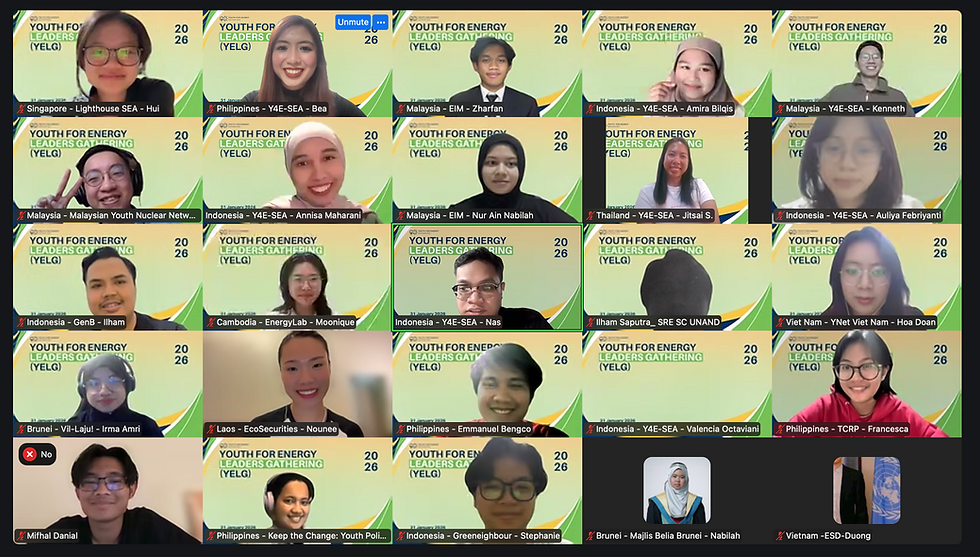
Virtual, January 31 2026 – Youth leaders from organizations working at the forefront of clean energy, sustainability, and just transition across Southeast Asia gathered for the inaugural Youth for Energy Leaders Gathering (YELG) 2026, a regional virtual convening organized by Youth for Energy Southeast Asia (Y4E-SEA).
The event brought together 23 youth-led organizations from across Southeast Asia, representing Brunei, Cambodia, Indonesia, Laos, Malaysia, Philippines, Singapore, Thailand, and Vietnam.
As the first-of-its-kind regional gathering dedicated to connecting youth-led energy actors across Southeast Asia, YELG 2026 marked an important milestone in strengthening youth collaboration for the region’s energy transition. The gathering created a shared space for dialogue, partnership, and collective action, bringing together emerging leaders committed to shaping a more inclusive and sustainable energy future.

A key highlight of the gathering was the Regional Roundtable Discussion titled “What Should We Do as a Region?”, moderated by Ms Amira Bilqis, Y4E-SEA Co-Founder and Managing Director. During the session, participants shared perspectives on community-level energy challenges, ongoing projects, and opportunities for cross-border collaboration, emphasizing the importance of strengthening alignment across Southeast Asia’s youth energy ecosystem.
To encourage open and honest dialogue among participants, the discussions during the gathering were conducted under Chatham House Rules, allowing participants to freely exchange ideas and experiences without attribution to specific individuals or organizations.Through these conversations, participants reflected on how youth-led initiatives, often rooted in local contexts, can move toward more coordinated regional impact.
Across the breakout discussions, participants identified several shared challenges shaping the energy transition in Southeast Asia. Many highlighted persistent energy affordability and access issues, with high electricity costs and continued dependence on fossil fuels affecting communities and economic development. Participants also emphasized that youth participation in energy policymaking remains limited, with young people often excluded from formal decision-making processes despite their growing involvement in climate advocacy. Another key concern was the knowledge gap surrounding energy technologies and policies, including misinformation and limited public understanding of topics such as renewable energy systems and nuclear power. Discussions also pointed to the workforce transition challenge, noting that while green jobs are emerging, training opportunities and career pathways in the clean energy sector remain uneven across the region. Finally, participants shared examples of community-driven initiatives, ranging from solar electrification projects and renewable energy education programs to waste management and policy advocacy efforts, highlighting the important role youth organizations already play in advancing local energy and climate solutions.

A central theme throughout the discussions was the recognition that youth efforts across Southeast Asia remain fragmented, with limited opportunities for cross-country collaboration and knowledge exchange. Participants emphasized the need for a regional platform where youth can share experiences, coordinate initiatives, and collectively track progress across the energy transition landscape. These discussions reinforced the importance of building stronger networks among youth energy actors to accelerate impact across the region.
The gathering also introduced the Y4E-SEA Regional Community, a partnership framework that brings together local energy stakeholders and formally recognizes organizations across Southeast Asia that are actively contributing to the energy transition. The Regional Community aims to strengthen cooperation among youth energy actors, increase the visibility of grassroots initiatives, enable knowledge-sharing and collaborative project development, and support more inclusive and youth-driven solutions under the Y4E-SEA framework.


Comments